
Best Water Features for Small Backyards: 7 Options That Won’t Overwhelm Your Space
Most homeowners assume a water feature means a full-sized pond, a footprint the size of a kiddie pool, and a weekend spent renting equipment. That assumption keeps a lot of small backyards in Zanesville and Cambridge quiet when they could have the sound of moving water right outside the back door.
The truth is that water features scale down just as well as they scale up. A postage-stamp patio, a narrow side yard, or a townhouse courtyard can all support a water feature that adds movement, sound, and a focal point without eating up the entire space or turning into a maintenance project. The key is picking the right type for the size you’re working with, not trying to shrink down a design that was built for a half-acre lot.
Here are seven water features that actually work in small backyards, along with what to think about before you install one.
Why Size Should Drive Your Water Feature Choice
Before getting into specific options, it helps to think about what “small backyard” actually means for water feature planning. A yard under a few hundred square feet has different constraints than a standard suburban lot, and those constraints should shape the decision more than personal taste alone.
Sun exposure matters more in a small space because there’s less room to tuck a feature into shade if algae becomes a problem. Sightlines matter too. In a compact yard, a water feature is usually visible from every angle, including from inside the house, so placement affects the whole space rather than just one corner.
Then there’s upkeep. Small yards often mean small budgets for ongoing maintenance, and a feature that needs constant skimming or water testing will get abandoned fast. The best water features for tight spaces are the ones that require the least fuss while still delivering the sound and visual interest homeowners are after.
Finally, consider how the feature will be used. Some homeowners want something to look at from a window. Others want to sit next to it on a patio. That distinction changes which type makes sense, since a feature meant for close-up enjoyment needs a different scale and sound profile than one meant to be viewed from a distance.
7 Best Water Features for Small Backyards
1. Pondless Water Features
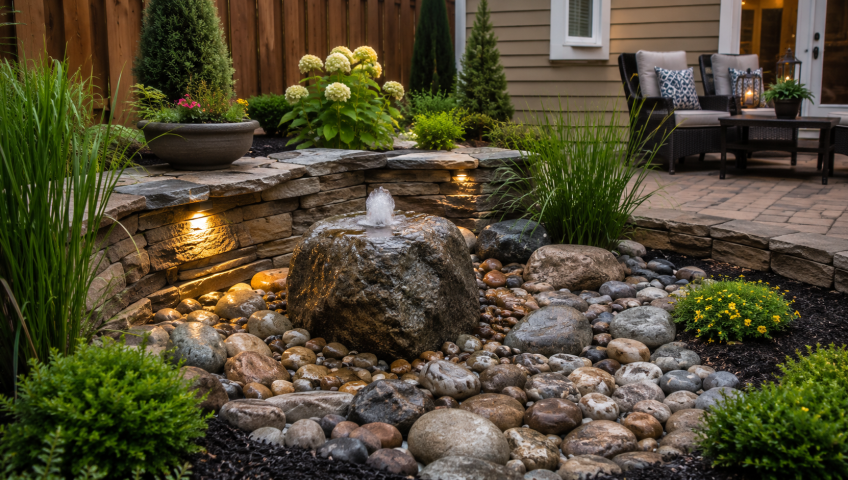
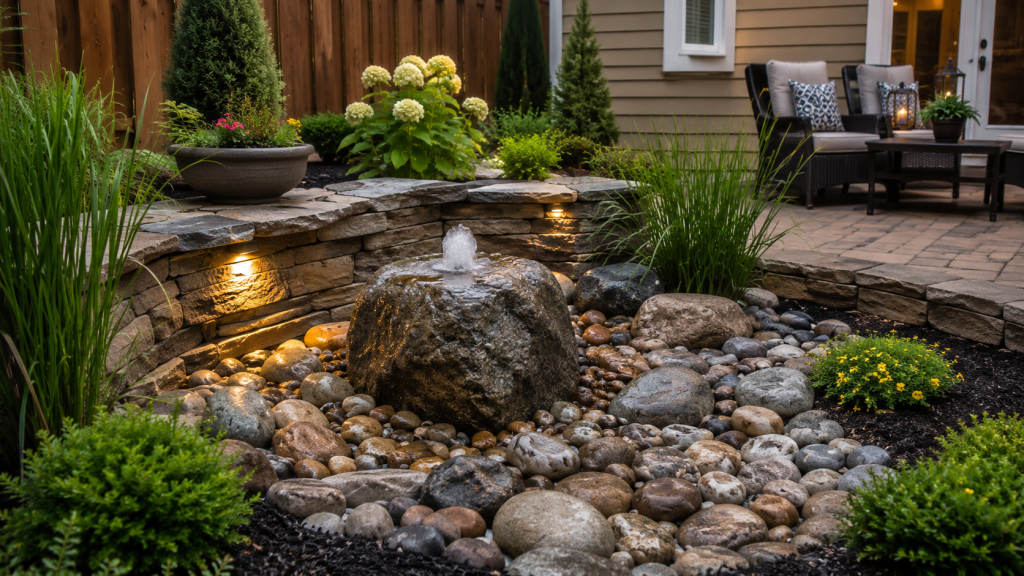
A pondless water feature, sometimes called a disappearing fountain or a bubbling urn system, moves water over rock or through a spillway and then recirculates it through a hidden reservoir underground. There’s no open basin, no standing water for mosquitoes to breed in, and no visible liner to maintain.
This is often the best option for small yards because the footprint can be as tight as a few feet across, and the design still delivers the sound of moving water that most homeowners are actually after. Since there’s no open surface for evaporation or debris to collect, upkeep is limited to topping off the reservoir occasionally and clearing leaves in the fall.
Pondless features also solve a real problem for families with young kids or pets, since there’s no open water to worry about. For a small backyard where every square foot counts, this is usually the first option worth considering.
2. Container Water Gardens
A container water garden uses a large pot, urn, or half-barrel as a self-contained mini pond. Add a small submersible pump, a few aquatic plants like dwarf water lettuce or miniature water lilies, and you’ve got a functioning water feature that takes up less space than a patio chair.
This option works especially well for renters, homeowners who aren’t ready to commit to permanent installation, or anyone with a patio or deck instead of a traditional yard. Container water gardens are also one of the more affordable ways to add a water feature, since the components are simple and widely available.
The tradeoff is that containers need more frequent attention than in-ground systems. Water levels drop faster in a smaller volume, and algae can build up quicker without a filtration system. Still, for a low-commitment way to test whether a water feature fits your space, this is a solid starting point.
3. Wall-Mounted Fountains
For yards with limited ground space but a usable wall, fence, or privacy screen, a wall-mounted fountain solves the space problem entirely. Water spills from a mounted basin or spout down a textured panel into a small catch basin below, and the whole system can be installed with almost no footprint.
Wall fountains work particularly well in narrow side yards or courtyard-style spaces where floor area is at a premium but vertical surfaces are wide open. They also make a strong visual anchor on an otherwise blank fence line, which is common in newer subdivisions where privacy fencing takes up a lot of the yard’s perimeter.
Because the water volume is small and contained, these systems are easy to maintain and rarely develop the murky water problems that plague larger ponds. They do need a nearby power source, so planning for that during installation avoids extension cord workarounds later.
4. Spillway Bowls and Bubbling Urns
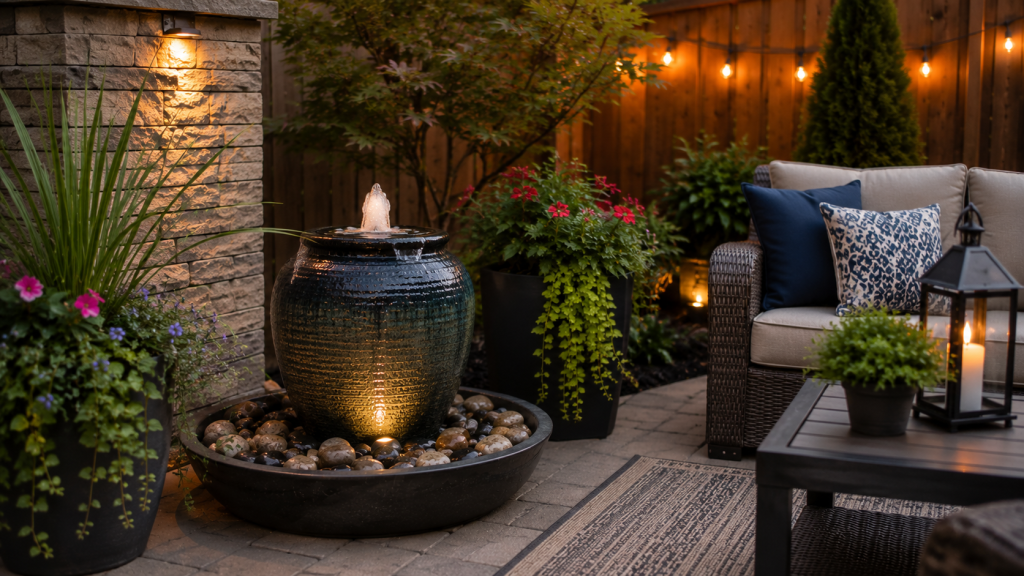
Spillway bowls and bubbling urns are close cousins of the pondless feature but scaled down even further. Water bubbles up through the center of a decorative bowl or urn and spills gently over the sides into a hidden basin below, all recirculated by a small pump.
These are ideal for entryways, small patios, or as an accent piece near a seating area rather than the centerpiece of the whole yard. Because the scale is so compact, homeowners can often place two or three of these throughout a small property to create ambient sound in multiple spots without any single feature dominating the space.
Maintenance is minimal since the water volume stays small and the design typically includes a screen or grate that keeps debris out of the reservoir.
[Image 2 placement: after the “Spillway Bowls and Bubbling Urns” section, before “Compact Preformed Ponds”]
File name: small-backyard-water-feature-patio-zanesville.jpg
Alt text: Compact bubbling urn water feature placed on a small patio next to seating area
5. Compact Preformed Ponds
If a homeowner wants an actual pond with fish or aquatic plants but doesn’t have room for a full excavation, a preformed pond shell scaled to a small footprint is worth considering. These come in pre-molded shapes that range from a couple feet across up to small koi-friendly sizes, and installation is far less invasive than a fully excavated and lined pond.
A compact preformed pond still requires a filtration system and periodic maintenance, since it holds standing water and can support fish and plant life. This makes it more of a commitment than a pondless feature, but for homeowners specifically drawn to the idea of fish or lily pads, it’s the smallest version of that experience available.
Placement matters here more than with any other option on this list. Preformed ponds need partial shade to control algae growth, and they need to sit somewhere that doesn’t collect runoff from the rest of the yard, since fertilizer or chemical runoff can harm fish and plants.
6. Tabletop and Patio Fountains
For the smallest yards, or for renters and apartment dwellers with a patio instead of a yard at all, a tabletop or freestanding patio fountain delivers water sound without any installation at all. These plug into a standard outlet, sit on a table or the ground, and can be moved whenever the layout changes.
This is the lowest-commitment option on the list, and it’s a good way to figure out whether the sound and presence of moving water is something a homeowner actually enjoys before investing in anything permanent. It also works well as a seasonal option, since these units can be stored indoors over winter rather than winterized in place.
The downside is scale. A tabletop fountain won’t carry sound across a larger patio or compete with traffic noise from a nearby street, so it works best as a close-range feature rather than a yard-wide focal point.
7. Small Recirculating Streams or Rills
A rill is a narrow, shallow channel of moving water, often just a few inches wide, that runs along a defined path rather than pooling in a basin. In small backyards, a short rill can run along a patio edge, connect two seating areas, or trace the border of a garden bed.
This option brings movement and sound into a yard without requiring a focal basin at all, which makes it a good fit for modern or minimalist landscape designs where a large decorative pond or urn would feel out of place. Because the water is shallow and constantly moving, rills tend to have fewer algae issues than standing water features.
Rills do require more precise grading than other options on this list, since the water needs a consistent, controlled path to follow. This makes professional installation worth the investment, since a poorly graded rill will pool in some spots and run dry in others.
Matching a Water Feature to Your Zanesville Yard
Local conditions play a bigger role in water feature planning than most homeowners expect. Zanesville’s hilly terrain and silt loam soil mean drainage and grading need attention before any feature goes in the ground, especially for preformed ponds and rills where water needs to move in a specific direction.
Sun exposure across a small yard can vary more than people assume, since a single mature tree or a neighboring fence line can shade half the space and leave the other half in full sun most of the day. Walking the yard at different times of day before choosing a spot helps avoid placing a feature somewhere that either bakes in direct sun all afternoon or sits in near-total shade where plants won’t thrive.
Homeowners in older Zanesville neighborhoods with mature landscaping often have the easiest time integrating a small water feature, since existing trees and beds already provide natural shade and structure to build around. Newer construction with less established landscaping may need a bit more design work to keep a water feature from looking like an isolated addition rather than a natural part of the yard.
Keeping a Small Water Feature Low Maintenance
Regardless of which option fits best, a few habits keep any small water feature running smoothly. Clearing leaves and debris in the fall prevents clogged pumps come spring. Topping off water levels regularly, especially during hot summer stretches, keeps pumps from running dry and burning out. And for anything with standing water, whether a container garden or a preformed pond, occasional algae treatment keeps the water clear without needing a full drain and refill.
Features with moving water, like pondless systems, rills, and spillway bowls, tend to need the least attention overall, since circulation naturally limits algae growth and there’s no open basin to skim.
A small backyard doesn’t have to mean giving up on the idea of a water feature. It just means choosing the right scale and style for the space available, and there are more options for that than most homeowners realize until they start looking.
Ready to add a water feature to your Zanesville or Cambridge backyard, no matter the size? Explore our water feature design and installation for custom fountains, pondless installations, and small-space solutions built to fit your yard, or call us today at (740) 704-7962 to talk through what would work best for your space.